 |
Sheep shearing at Yandilla Station, ca. 1894
Sheep shearers working in a shed at Yandilla Station.
A supervisor or manager in a hat, vest, shirt and trousers
and a tarboy in rough clothes pose for the photograph.
(A tarboy assists by dabbing tar or antiseptic on any cuts suffered
by the animals during shearing. |

Showing posts with label Bushranger Era. Show all posts
Showing posts with label Bushranger Era. Show all posts
Friday
Shearing in the bushranging era

Monday
Australian life in Queensland in the bushrangers time
The bushrangers roamed Australia during the 1800's. The term bushranger was first used in a newspaper in 1805. Here is are some images of what life was like in the northern state of Queensland during that time.
You might like to find out more about:
 |
| Mounted Police station in Cooktown. Barracks and police station in the country above Cooktown 1878 |
 |
| Hopetoun selection in southern Queensland. |
 |
| Edward McDermott's grocery store in Brunswick Street, Fortitude Valley, Brisbane, ca 1884 |
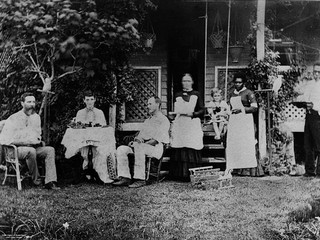 |
| Family having tea in the garden of Richmond Hill homestead, Mackay, Queensland, ca. 1890 |
 |
| Group of women having a tea party in Queensland, ca. 1887 |
 |
| Reading the paper in a Gympie garden, ca. 1871 |
 |
| Blacksmith shop, Oxley Road, Oxley, Brisbane 1888. |
 |
| Gold miners outside a bark hut, Queensland, ca. 1870 Two gold miners dressed in working clothes outside a slab bark hut with mining tools nearby |
- gold mining in Australia in the bushranger days.
- bush homes in the 1800's.
- what bushrangers ate.
- From the bookstore: Blacks and Bushrangers. Adventures in Queensland ... With Illustrations By Edward B. Kennedy.
Tuesday
What did bushrangers eat?
 |
| Pioneer settler's home in the Australian bush |
What a bushranger ate, when they were in the bush, would depend upon many factors:
- what part of the country they were in
- their own bush survival skills
- if they were actively on the run from the authorities
- if they knew free settlers who would support them
When bushrangers were being hunted by police and trackers it would have been difficult to stop and cook food over a fire.
Some bushrangers stole provisions owned by the settlers or travellers or store owners if they were near a town, helping themselves to salted meats, potatoes, onions and flour. Some were supported by free settlers who had been convicts and were sympathetic to the bushrangers hatred of authority.
Bushrangers may have known about native plants that they could eat such as stinging nettle, prickly pear and tea tree but this is not documented.
Monday
The call of the Australian Bush 1880
 |
| 1880 Northern Queensland Australia Travelling through the bush in the Cooktown District |
The road is rough - but to my feet
Softer than is the city street;
And then the trees! - how beautiful
She-oak and gum - how fresh and cool!
Softer than is the city street;
And then the trees! - how beautiful
She-oak and gum - how fresh and cool!
From The Call of the Bush by Dora Wilcox,
born Mary Theodora Joyce Wilcox (1873-1953) poet and playwright.
Sunday
A bush home in Australia in 1895

The first settlers endured the inclement climate and the harshness of the bush as they went forth into the forest with the manly determination to reclaim the wilderness and to make themselves a home in its previously unbroken solitudes. To do this, has involved no small amount of courage, of patient endurance, of steadfast hope, of physical strength and of pertinacious toil. Picturesque Atlas of Australasia: published in 1886.
It's hard to tell from this photo, due to the fence, whether it is a fully wooden construction called a bark hut or a slab hut or a wattle and daub home.
Bark Hut
A hut almost entirely made from the stringy bark tree which was chosen because of its straight grain. The bark was stripped and cured before being used to create the walls.
Slab Hut
A hut made from slabs of split or sawn timber, often in a vertical construction. Timber was split along the grain and used green not seasoned.
Wattle and daub
The wattle is the horizontal weaving of thin branches between vertical stakes.
Daub is the binding ingredient usually made of clay in Australia mixed with wet soil, or sand, animal dung and straw.
LINKED UP AT: History and Home
Thursday
Family group in front of rough bush dwelling
 |
| 1870's |
Learn about the construction of other buildings in the 1800's.
Linked to Oh My Heartsie Reviews, Twinkle in the Eye, Today in History...on your site
Wednesday
1873 photo of Bank of NSW in Warwick
 |
| Photographer: William Boag |
This building was erected by the Bank of NSW in Palmerin Street, Warwick opposite the Warwick Dispensary in 1871 and opened for business in February 1872.
In 1842 Governor Gipps declared that 'all settlers and other free persons shall be at liberty to proceed to the Darling Downs in like manner as to any other part of the Colony.' Warwick was the first town on the Darling Downs established on the banks of the Condamine River. The Leslie brothers first settled in the area as squatters and in 1847 the NSW government asked them to select a site for a township. The local Aborigines called the area as Gooragooby, it was going to be called Canningtown but the name Warwick was chosen.
Sunday
The early streets of Rocklea, Brisbane
 |
| Horses and riders outside the Crown Hotel, Rocklea, Queensland in 1899. John Oxley Library, State Library of Queensland |
This way of placing the licensees name prominently can also be seen in the 1880 photo of The Glenrowan Inn, site of the Kelly Gang shoot out in that year.
Monday
Bush School 1872
 |
| Logan/Beenleigh area, Queensland |
This is believed to be the Logan non-vested (non-Government funded) school, established in 1870, in what school inspectors described, at the time, as a 'new, well-ventilated, and roomy building'.
The structure also was used as a place of worship.
One teacher was employed to teach 58 children. He was reported to be 'painstaking and conscientious', but the level of attainment was regarded as very low, caused by the irregular attendance. Among the subjects offered, geography, writing and spelling were regarded as 'especially imperfect'.
Thursday
Lunch in the bush

Lunch in the bush, near Warwick, Queensland, ca.1893.
A man and woman stopping for a meal and a billy of tea. The horses have been unhitched from the double buggy. The double buggy was advertised as 'a must for squatters' as it was admirably adapted to travelling over huge logs and rutted ground. Travel in Australia during the late 1800s would have been very difficult.
RESOURCE: John Oxley Library, State Library of Queensland.
Tuesday
Hyde Park Barracks

Hyde Park Barracks, Sydney,
drawing by Hardy Wilson in 1914.
National Library of Australia image.
Saturday
Melbourne in the 1800's

Detail from the Cyclorama of Early Melbourne by John Hennings
In 1892, the Victorian government commissioned John Hennings to paint a cycloramic painting of Melbourne. Hennings was paid 500 guineas (about A$1000) for his work which took five months to complete.
A cyclorama was a pictorial entertainment that was popular in Europe and America from the late 18th century until the arrival of cinema at the end of the 19th century.
Hennings was born in Germany in 1835 and arrived in Australia in 1855.
RESOURCE: State Library of Victoria
'The Immigrants first Christmas in Queensland'

New settlers pictured outside their tent,
celebrating their first Christmas in Queensland Australia.
Copied and digitised from an image appearing in the The Illustrated News-Budget, 23 December, 1911.
Thursday
ROBBERY UNDER ARMS

The St Kilda Road was the scene of frequent hold-ups during the Victorian gold rush by bushrangers. During the gold rush a temporary camp was set up for new arrivals and it was called Canvas Town. It was in the part of St Kilda Road between Canvas Town and Melbourne that most hold ups occurred. The bushrangers, who conducted the holdups, were thought to be mostly former convicts from Van Diemens Land which is now called Tasmania.
Find out more background to the art work PDF
Subscribe to:
Posts (Atom)
